Strength vs Power: Why Explosiveness Matters More Than You Think
When most people think of athletic performance, they think about strength. Heavy squats, big bench presses, loaded deadlifts. Strength absolutely matters — it’s the foundation of movement. But strength on its own isn’t the full picture.
A strong athlete is not always a powerful athlete. Power is strength expressed quickly. In other words, it’s not just about how much force you can produce, but how fast you can produce it.
If you want to learn more about this topic, you can watch Ellie Richardson's lecture here:
The Force–Time Curve: Strength meets speed
Imagine a simple graph: force on one axis, time on the other.
▪︎ Heavy lifts sit toward the “high force, long time” end.
▪︎ Plyometrics and ballistic movements sit on the “low force, short time” end.
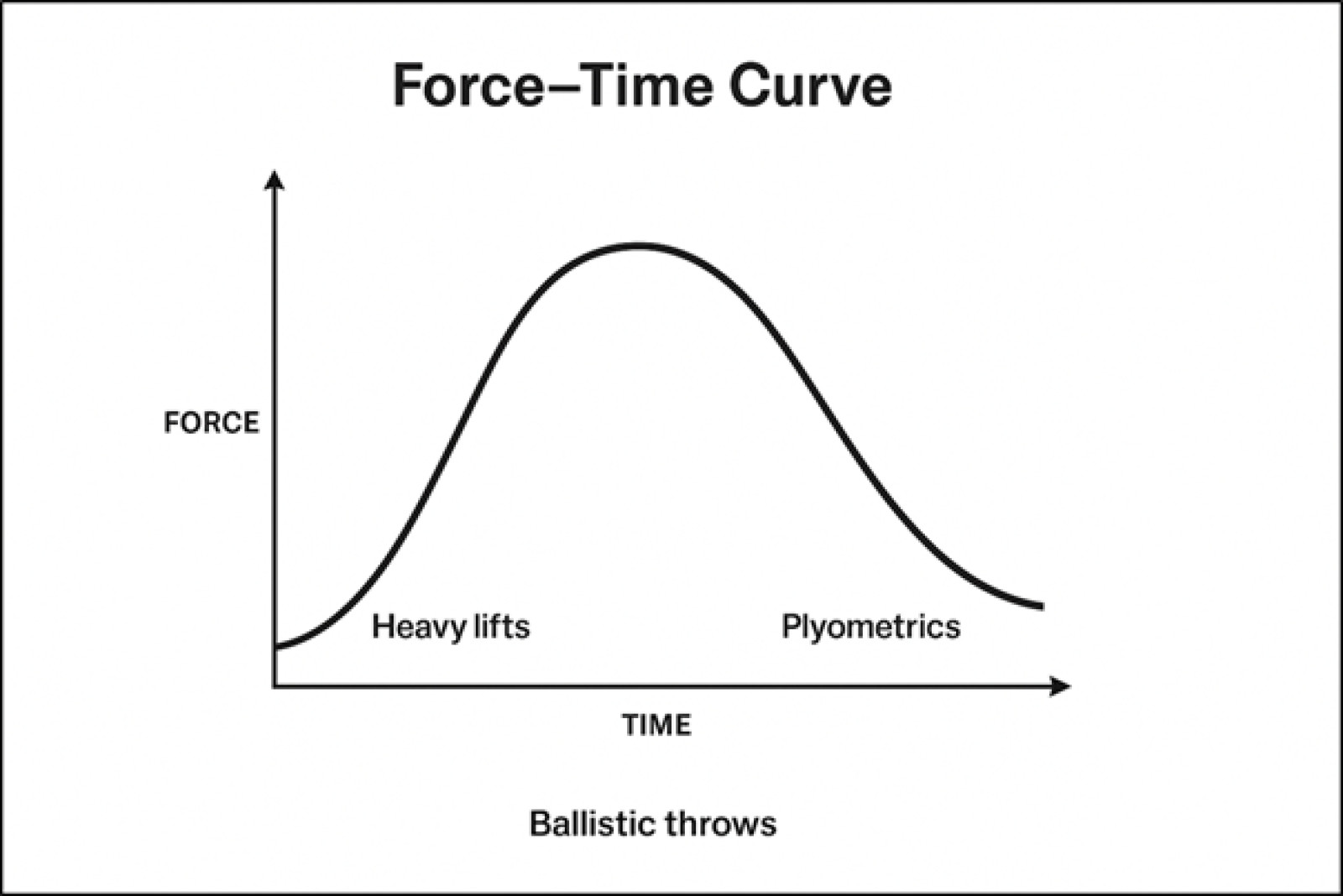
Athletes live in between. Too much slow strength training and you risk being strong but sluggish. Too much speed work without a strength base, and you lack the raw horsepower.
The magic happens when you train across the curve — blending heavy lifts with explosive movements.
Plyometrics vs Ballistics: What’s the Difference?
Both plyometric and ballistic exercises train explosiveness, but they’re not the same.
Plyometrics (like box jumps or depth jumps) use the stretch–shortening cycle — your muscles store elastic energy and then release it quickly. Think of a spring being loaded and snapped.
Ballistic movements (like medicine ball throws) accelerate through the entire range of motion, with no braking phase at the end. That’s why you actually “let go” — the ball leaves your hands, the bar leaves your shoulders.
👉 Plyometrics teach you to use stored elastic energy.
👉 Ballistics teach you to accelerate without holding back.
Together, they fill different gaps on the force–time curve.
Why Shoulders Need Ballistics?
When we think of explosive training, we often think of legs — sprints, jumps, Olympic lifts. But the shoulders are key for upper body power, whether you’re throwing, punching, or pressing.
Here’s the challenge: heavy pressing builds strength, but it doesn’t always translate to explosive shoulder power. That’s where ballistics come in.
▪︎ They train rate of force development (RFD) — how quickly your muscles can generate force.
▪︎ They tighten up kinetic chain timing — coordinating legs, core, and shoulders as one.
▪︎ They use loads your shoulders actually like — medicine balls, bodyweight, and lighter implements instead of only heavy bars.
5 Ballistic shoulder exercises to build explosive power
1. Medicine ball chest pass
Mimics a bench press, but with speed. Great for upper body drive.
2. Medicine ball chest pass against wall
Drive the ball through the wall — fast hands, full extension.
3. Rotational medicine ball throw
Builds rotational power, crucial for athletes in throwing, striking, or rotational sports.
4. Push, press, throw
Uses leg drive + shoulder extension to move the load explosively. Perfect for blending lower and upper body.
5.Plyometric push-ups
Bodyweight ballistic. Hands leave the ground, forcing rapid force production in pressing muscles.
Key Takeaway
Strength is the foundation. But strength without speed leaves a gap. If you want to jump higher, punch faster, throw harder, or simply feel more athletic — you need to train across the force–time curve.
▪︎ Heavy lifts build force.
▪︎ Plyometrics sharpen reactivity.
▪︎ Ballistics build explosive speed through the full range.
Don’t just be strong. Be powerful.
If you want to learn more about this topic, you can watch Ellie Richardson's lecture here:
Source:
From the lecture ‘Strength and Conditioning for Shoulder Rehab' by Ellie Richardson